Handbook
Autonomy levels
Operator hub for the L0–L8 execution ladder: what each level means, which Forge Platform building blocks participate, and what is implemented today versus vision.
Policy (unit of delivery, fixed boundaries, human gates) is canonical in the Blueprints handbook. This section is the adoption and reference-architecture surface — scan readiness here, then open a per-level page for building-block wiring.
The ladder carries two finer axes (canonical definitions in Blueprints): maturity grades a–d — Defined, Demonstrated, Repeatable, Operational — on every level, and sub-levels L1.1–L4.3 in the L1–L4 band, each with distinct assay evidence. Claims use the notation L<level>.<sub><grade> plus scope, for example L2.2c in forge-lenses. Per-project observed maturity and scoring: Autonomy maturity framework (Blueprints).
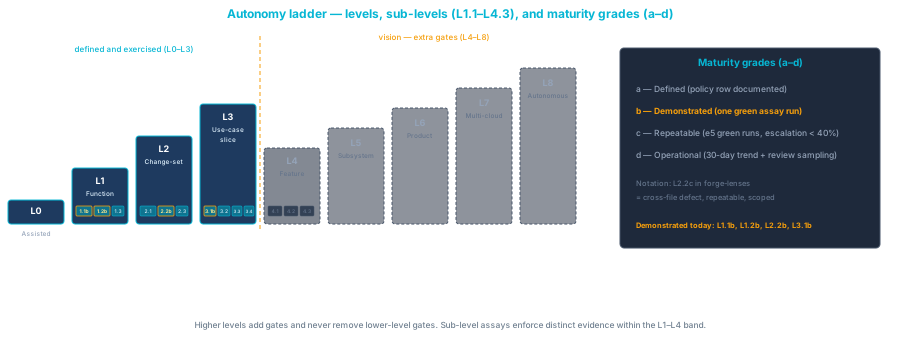
Previous flat ladder diagram (autonomy-levels-progression.svg) retained for reference. Sub-level run anatomy: sublevel-run-evidence-flow.svg. Maturity scoring: maturity-score-composition.svg and Autonomy maturity framework (Blueprints).

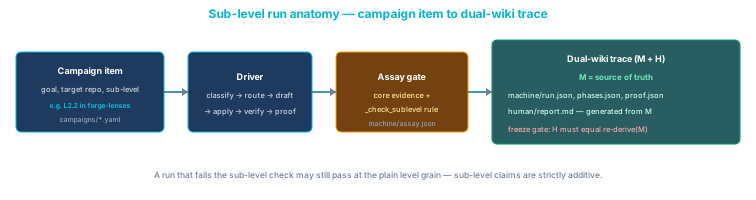
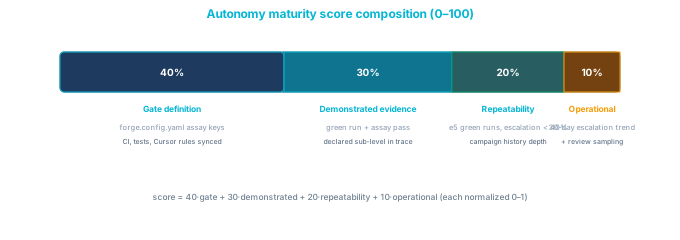
Worked runs with machine evidence: Bounded execution examples (Blueprints). PoC → Platform migration: PoC to Platform.
How to read a level
Each per-level page follows the same progression:
- Unit of autonomous delivery — what the unattended run may change
- What stays fixed — architecture, contracts, platform boundaries
- Human gate — where a person still decides
- Building blocks — which ecosystem elements participate (with handbook links)
- Gates and evidence — what must pass before the change counts as done
Higher levels add gates; they never remove lower-level ones.
Implementation readiness
| Level | Policy | Grade | Assay / enforcement | PoC demonstrated | Platform workcell path | Architecture |
|---|---|---|---|---|---|---|
| L0 Assisted | Defined | a | N/A (interactive) | N/A | Cursor + Lenses Wizard | L0 |
| L1 Function | Defined | b | Documented + Dark Factory code | Yes (Examples 1–2; retro-tags L1.1b, L1.2b) | Dark Factory PoC; LCDL patch units | L1 |
| L2 Change-set | Defined | b | Documented + code (≥2 files) | Yes (Example 3; retro-tag L2.2b) | Same PoC stack | L2 |
| L3 Use-case slice | Defined | b | Documented + code (layers, py+non-py, E2E) | Yes (lenses-production-l3-ci; retro-tag L3.1b) |
Same PoC stack | L3 |
| L4 Feature/component | Defined (vision gates) | a | Vision only | No | Vision: Forge Campaign | L4 |
| L5 Subsystem | Defined (vision gates) | a | Vision only | No | Vision: Campaign + ADR escalation | L5 |
| L6 Product increment | Defined (vision gates) | a | Vision only | No | Vision: Campaign + Fleet | L6 |
| L7 Multi-platform | Defined (vision gates) | a | Vision only | No | Vision: multi-repo orchestration | L7 |
| L8 Autonomous problem solving | Defined (vision gates) | a | Vision only | No | Vision: mission framing only | L8 |
Status legend: Defined = ladder row and gates documented in Blueprints (grade a). Demonstrated = green PoC run with machine evidence (grade b). Vision = policy table only; no PoC or Platform-native level enforcement yet. Grades c (Repeatable, ≥5 green runs with escalation rate < 40%) and d (Operational) are defined in Blueprints but not yet earned anywhere.
Sub-level index (L1–L4 band)
Sub-levels are named variants of the autonomous unit, each with its own checkable assay evidence. L0 and L5–L8 stay flat.
| Sub-level | Autonomous unit | Status | Page |
|---|---|---|---|
| L1.1 | Single function against provided tests | Demonstrated (retro-tag) | L1.1 |
| L1.2 | Function + agent-authored unit tests | Demonstrated (retro-tag) | L1.2 |
| L1.3 | Batch of N independent functions in one run | Defined | L1.3 |
| L2.1 | Mechanical multi-file (rename / apply-pattern) | Defined | L2.1 |
| L2.2 | Cross-file defect fix | Demonstrated (retro-tag) | L2.2 |
| L2.3 | Small behavior change with new tests | Defined | L2.3 |
| L3.1 | Slice in sandbox app | Demonstrated (retro-tag) | L3.1 |
| L3.2 | Slice in a production repo on a branch | Defined | L3.2 |
| L3.3 | Slice including data/schema migration | Defined | L3.3 |
| L3.4 | Multiple slices under one campaign | Defined | L3.4 |
| L4.1 | New component, single repo | Defined (vision gates) | L4.1 |
| L4.2 | Cross-repo change-set with submodule bump | Defined (vision gates) | L4.2 |
| L4.3 | Capability with agent-drafted, human-signed ADR | Defined (vision gates) | L4.3 |
Wizard vs execution ladder
Forge Lenses Wizard captures planning-time autonomy separately from runtime unattended loops. Names overlap at L0–L3 but serve different layers.
Wizard AutonomyLevel |
UI title | Execution ladder | Notes |
|---|---|---|---|
l0_analyst |
L0 Analyst | L0 Assisted | Read-only analysis; no drafts without you |
l1_drafter |
L1 Drafter | L1 Function | Drafts for review before share |
l2_stage_autopilot |
L2 Stage Autopilot | L2 Change-set | Multi-step work inside current stage with gates |
l3_goal_autopilot |
L3 Goal Autopilot | L3 Use-case slice | Goals across stages with checkpoints |
Wizard MutationPolicy describes how far downstream automation may edit artifacts. Policies inform prompts; they do not silently apply upstream edits. Persisted session policies should match the execution level you intend for unattended runs.
Wizard domain model: Forge Lenses docs/blueprints/wizard-domain-model.md (repo). Planning mirror: Cost-aware planning.
Level index
| Level | Name | Status | Page |
|---|---|---|---|
| L0 | Assisted | Defined (a) | L0 — Assisted |
| L1 | Function | Demonstrated (b) | L1 — Function |
| L2 | Change-set | Demonstrated (b) | L2 — Change-set |
| L3 | Use-case slice | Demonstrated (b) | L3 — Use-case slice |
| L4 | Feature/component | Vision (a) | L4 — Feature/component |
| L5 | Subsystem w/ local arch evolution | Vision (a) | L5 — Subsystem |
| L6 | Product increment | Vision (a) | L6 — Product increment |
| L7 | Multi-cloud / multi-platform | Vision (a) | L7 — Multi-platform |
| L8 | Autonomous problem solving | Vision (a) | L8 — Autonomous problem solving |
Resource honesty (local-first)
Fully cloud-free autonomy above L1 is not realistic on a ~4GB local model profile. See Respecting resources and autonomy and Blueprints Respecting resources.
| Level band | Realistic local-first posture |
|---|---|
| L0–L1 | Achievable with deterministic routing + local worker + verify/repair |
| L2–L3 | Often needs ROI-gated escalation to a larger model or human at pivots |
| L4+ | Requires explicit human gates (ADR, go/no-go, strategic checkpoints) regardless of model |
Track escalation rate (human loop escalation, not worker-ladder stepping) — see Respecting resources.
Related
- PoC to Platform — Dark Factory loop → ForgeRun / Campaign migration path
- Platform reference architecture — ecosystem elements and data flows
- Agents and workcells — ForgeRun, AgentRun, workcell catalog
- Respecting resources and autonomy — interactive vs bounded execution
- Autonomy levels (Blueprints — canonical policy)
- Bounded execution examples